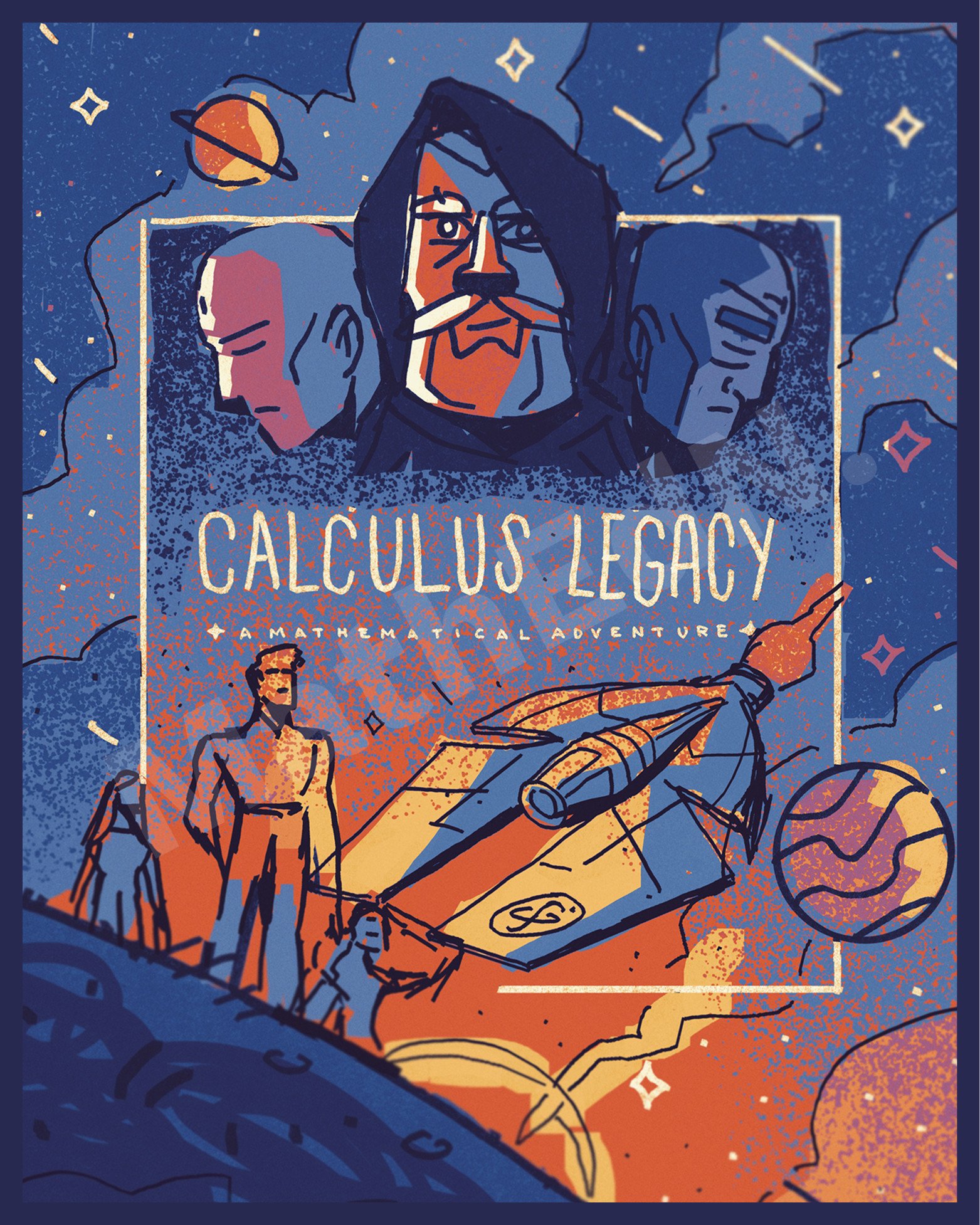
Brewing Alien Beer: Calculus Legacy as a Ludo-Didactical Experiment in a First-Year Engineering Calculus Course
A team at Maastricht University is reimagining how first-year undergraduate engineering students learn calculus through Calculus Legacy, a narrative-driven legacy board game built around Problem-Based Learning and real-world applications. A recent pilot offered a bittersweet but valuable baseline revealing minimal grade differences, yet clear areas to refine the first iteration of the game.
Calculus is a foundational course in STEM programs, closely connected to various engineering disciplines, yet many first-year students experience this subject as abstract and demotivating. It often functions as a “gatekeeper course” hindering students’ motivation to continue. From this perspective, we redesigned the tutorials of a first-year calculus course with improved teaching philosophies, leading to the development of a board game called Calculus Legacy.
The aim was not to “gamify” calculus for shallow entertainment, but to explore whether a physical legacy-style board game could serve as an alternative tutorial format while maintaining constructive alignment. We aimed to investigate whether this approach could: 1) maintain or improve academic performance, 2) enhance student engagement and motivation, and 3) support collaboration and ownership of learning.
Calculus Legacy was developed within a Comenius Teaching Fellow project allowing us to work through the full ADDIE cycle with a team of educators and student assistants over 1.5 years. The design was informed by ludodidactics, a pedagogical design framework developed at Utrecht School of the Arts.
The game was played across seven tutorial sessions, each aligned with a core calculus topic: functions, limits, derivatives, applications of derivatives, integrals, applications of integrals, and differential equations. The first pilot was content-ready but visually improvised, with many components iteratively adjusted during the course. A professional designer later joined to develop a more polished visual version.
The pilot was embedded in a regular first-year engineering calculus course. To evaluate Calculus Legacy, we used an experimental two-track approach approved by an ethics review committee. Students were randomly assigned to either a standard track (regular tutorials) or a game track (using Calculus Legacy). Both tracks shared identical lectures, weekly automated quizzes, and a final exam. Differences were limited to the tutorial format and some coursework.
After a small number of opt-outs in the second week, the game track stabilized at 12 students, organized in three groups of four players. Students who opted out indicated reasons such as “this approach is not for me” and “the game session felt rushed,” highlighting the importance of pacing and expectation management in this type of design.
In one game session, for example, students help alien monks design a beer glass using integrals for volume, surface area, and mass calculations with evolving engineering constraints. Each session replaced a standard 90-minute tutorial and aligned directly with the course lectures. Remaining tutorials focused on revision, Q&A, and conceptual deepening. Throughout the process, ludodidactics has aligned remarkably well with teaching principles of our university. Learning in Calculus Legacy shows to be constructive and active, collaborative, contextual, and self-directing.
Our data sources included weekly quiz scores, final exam grades and pass rates, group portfolios, individual reflections, pre- and post-course engagement surveys, and observational notes; supplemented by follow-up focus groups that are currently being conducted.
Academically, the results were both reassuring and instructive. Quiz scores and exam grades showed no statistically significant differences between the two tracks. However, pass rates were higher in the game track, suggesting that the game may still have had a positive impact on students.
Surprisingly, self-reported engagement results were higher in the standard track. We suspect several factors: the cognitive load of a new format, the rough visual prototype, and the act that “feeling engaged” does not always align with being productively engaged. Follow-up focus groups with both tracks, separate and mixed, are planned to explore this observation in more depth.
Qualitatively, we observed strong collaboration in the game groups, rich mathematical discussions, and clear ownership of problem-solving in the game track, once students became comfortable with the game-based approach, format, and role structure. The main challenges were onboarding, time pressure, and some initial resistance to the non-traditional format. A key lesson for colleagues considering similar approaches is that user adoption and expectation management are at least as important as the game mechanics themselves.
In hindsight, the pilot confirmed two main insights. First, the existing calculus course was already robustly designed, matching the baseline is already a meaningful result. Second, Calculus Legacy shows potential, but needs refined scaffolding, visuals, and more gradual onboarding for students. We are currently designing the game with professional support to prepare a fully open, printable version of the game for other teachers to use and adapt.
Curious to try this in your own course or to discuss further? Reach out to our team at www.edudacs.nl !