Preparing Undergraduate TAs for Mathematics Tutorials
Mathematics tutorials at our university are mostly led by second- and third-year bachelor students who stay as TAs for only a year or two. They often struggle with unexpected questions, feedback, group work and consistent grading. Surveys and interviews with lecturers and TAs confirmed the need for mathematics-specific training. We designed a three-hour module with role-plays on discussions and misconceptions, a “hint hierarchy” for feedback without giving away solutions, and rubric-based grading. After a pilot in March 2026 and a regular edition in August 2026, participants rated it about 4.4 out of 5. Next steps are harder example problems, clearer role-play instructions and peer observation.
In our mathematics courses, much of the real work happens in the tutorials, and most of those tutorials are led by undergraduate teaching assistants. Over the years we kept seeing the same problems in tutorial groups, and they had little to do with how well the TAs knew the mathematics. Inspired by the examples of TA trainings in North America, we decided to design a training specifically for mathematics TAs.
Below we explain why we thought such a training was needed, what we learned from lecturers and TAs, and what the training looks like.
The issues
Most mathematics courses at our university have two lectures and two tutorials a week. The tutorials are not an extra. They are where students work through enough examples and actively solve problems, which is known to improve understanding and performance (Freeman et al., 2014). So the quality of our tutorials largely determines the quality of our mathematics education.
The TAs who run these tutorials are mostly second- or third-year bachelor students. They often teach a course they took only a year earlier, and they usually TA for just one or two years before graduating. This is very different from North America, where TAs are typically PhD students who teach for four to six years and grow into the role. Our high turnover means teaching expertise never has time to build up.
In tutorials we repeatedly saw TAs struggle to address diverse student needs, give constructive feedback, manage group work, and grade consistently. The university’s Centre for Learning and Teaching (CLT) offers a good general training of about 21 hours, but it is not specific to mathematics. We therefore set out to design a training module that would help TAs:
- Facilitate mathematical discussions and deal with common misconceptions;
- Give feedback that moves students forward without revealing the solution;
- Grade rigorously, consistently and efficiently;
- Build on the existing CLT training rather than duplicate it.
What lecturers and TAs told us
Before designing anything, we wanted to check whether our impressions were shared. We sent one survey to lecturers and one to current and former TAs, and we interviewed six lecturers, including the programme director of BSc (Applied) Mathematics.
The lecturer survey was completed by 16 lecturers, about half of those who work with TAs. Of them, 88% called TA involvement “very important”, yet only half provide any orientation or training to their TAs. The main reasons were lack of time and uncertainty about what such training should contain.
The TA survey was completed by 51 current and former TAs, 40% of whom come from programmes other than mathematics. Their most common challenges were:
- Responding to unexpected questions (56%);
- Managing tutorial time;
- Encouraging student participation;
- Grading consistently and efficiently.
Asked what training they would value, 66% chose mathematics-specific teaching strategies, followed by classroom management (64%), difficult student interactions (51%) and fair grading (50%). Several TAs felt the existing training was a bit too broad to help with things like explaining proofs or grading work that can be solved in several ways.
The interviews added depth. Lecturers wanted concrete strategies rather than abstract principles, and clear expectations about what a TA should and should not do. Several noted that TAs who were strong students themselves often find it hard to see why others struggle. Grading came up again and again, with inconsistencies both within one TA’s work and between TAs on the same course.
The literature points the same way. In biology, students taught by trained undergraduate TAs did as well as those taught by graduate TAs (Chapin et al., 2014), but mathematics lecturers elsewhere have also found generic training insufficient for their discipline (Mond, 2005; Cox & Mond, 2010).
Setup of the training
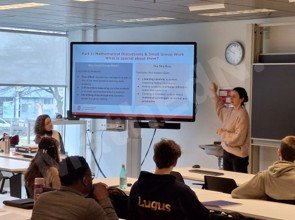
The result is a Mathematics Module of about three hours, designed to fit into the STEM part of the existing CLT training. We worked with Agata Szperl to make sure it complements what CLT already offers. The module consists of three interactive activities of 45 to 50 minutes each, plus a short introduction and wrap-up. TAs also receive handouts they can keep using during the semester.
Activity 1: Mathematical discussions and misconceptions. Before the workshop, TAs solve one of the problems we will use and think about where students might get stuck. In the session they role-play tutorial situations from scenario cards, such as “The Silent Group”, “The Correct Answer, Wrong Reasoning” and “The ‘We’re Done!’ Group”, and then reflect on what worked.
Activity 2: Feedback without revealing solutions. TAs sort example responses to a student working on “Prove that if n² is even, then n is even”. Some responses give too much away (“Assume n is odd and write n = 2k+1”), some too little (“Look at your notes”), and some are just right (“What happens if you assume n is odd? Can you write that algebraically?”). They then practise a “hint hierarchy” on real-looking student work, starting with open questions and moving to more specific hints only when needed. This builds on research on tutoring (Chi et al., 2001) and inquiry-based learning (Laursen et al., 2014).
Activity 3: Grading. TAs first grade anonymised student solutions without a rubric, compare their grades and build a rubric together. They then grade a proof-based problem with a ready-made rubric and discuss ambiguous cases, such as wrong reasoning that leads to a correct answer. We close with practical strategies: grade per question rather than per exam, set yourself a time limit per question, and re-check earlier papers now and then.
Following the training, we plan to introduce a system in which TAs observe each other’s tutorials and provide feedback using a structured rubric, coordinated by an experienced TA. We also aim to organise one follow-up meeting per term, providing TAs with an opportunity to share their challenges, experiences, and successes.
Results
We have now run the training twice: a pilot in March 2026 and a first regular edition in August 2026. After each session, participants filled in an anonymous evaluation, 17 in the pilot and 24 in August.
The two groups were quite different. In the pilot, 9 of the 17 respondents had TA experience, including a PhD student, while in August 23 of the 24 had never been a TA. Both groups came from a wide range of programs, including physics, computing science, artificial intelligence, astronomy and engineering. Only 7 pilot respondents and 6 August respondents were enrolled in a mathematics program, which confirms how many of our TAs are not mathematics students.
Participants rated the training 4.35 out of 5 in the pilot and 4.42 in August, and nobody gave it less than 3. Asked whether the training will help them facilitate mathematics tutorials, they answered 4.29 and 4.46 on average. The evaluations yielded the following positive feedback.
- Nearly all participants said they felt more confident about the challenges they had identified beforehand.
- The main takeaway was strikingly consistent: guide students with questions instead of giving them the answer. Several participants named the hint hierarchy specifically.
- Participants valued the interactive format, especially the group work, the role-plays and the chance to practise skills on the spot.
- The grading activity was a highlight for many. One participant wrote they were “very glad that I had some training in how to apply grading using a scheme”.
- Several participants stressed the value of mathematics-specific training. One even asked us to “make this class compulsory for TAs of math courses!”
We also received the following critical feedback.
- In both editions, participants found some example problems too easy to spark a real mathematical discussion, especially in the first activity.
- The role-plays divided opinion. Several participants found it hard to judge how little to know when playing the student, while others asked for more role-play because it made them feel more prepared.
- Time was tight. Some activities could not be completed, and a few participants wanted more attention for time management, grading or academic integrity.
These comments point clearly to our next steps: more challenging problems for the discussion activities and clearer instructions for the role-plays.
In the long run, we hope an experienced TA, possibly a PhD student, will facilitate the training, with us as mentors. We are also exploring funding for a PhD project. While biology has studies comparing undergraduate and graduate TAs, similar research in mathematics is limited.
Two Rounds In: From Plan to Practice
What struck us most in the needs analysis was how much lecturers and TAs agreed. Lecturers want better-prepared TAs but lack the time to train them, and each of them currently reinvents TA preparation on their own. TAs, in turn, ask for practical, mathematics-specific guidance and for opportunities to practise with feedback.
The benefits should reach beyond our own tutorials. Mathematics courses serve students in many different programs, so better tutorials can support a much wider group than mathematics students alone. For the TAs, the training builds skills such as clear communication and giving feedback, which are useful far beyond teaching. It may even encourage strong bachelor students to stay for a master’s degree, since trained students are more likely to get TA positions.
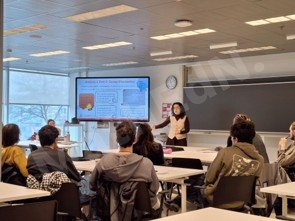
So far we have run the training twice, first as a pilot and then a second time. We are looking forward to refining it in further iterations, and to finding out whether it delivers what lecturers and TAs asked for.
References
Chapin, H. C., Wiggins, B. L., & Martin-Morris, L. E. (2014). Undergraduate science learners show comparable outcomes whether taught by undergraduate or graduate teaching assistants. Journal of College Science Teaching, 44(2), 90–99.
Chi, M. T., Siler, S. A., Jeong, H., Yamauchi, T., & Hausmann, R. G. (2001). Learning from human tutoring. Cognitive Science, 25(4), 471–533.
Cox, B., & Mond, D. (2010). Training in teaching for new staff in UK university mathematics departments.
Freeman, S., Eddy, S. L., McDonough, M., Smith, M. K., Okoroafor, N., Jordt, H., & Wenderoth, M. P. (2014). Active learning increases student performance in science, engineering, and mathematics. Proceedings of the National Academy of Sciences, 111(23), 8410–8415.
Laursen, S. L., Hassi, M. L., Kogan, M., & Weston, T. J. (2014). Benefits for women and men of inquiry-based learning in college mathematics: A multi-institution study. Journal for Research in Mathematics Education, 45(4), 406–418.
Mond, D. (2005). Warwick teaching certificate (mathematics): An experiment in departmentally-based training.